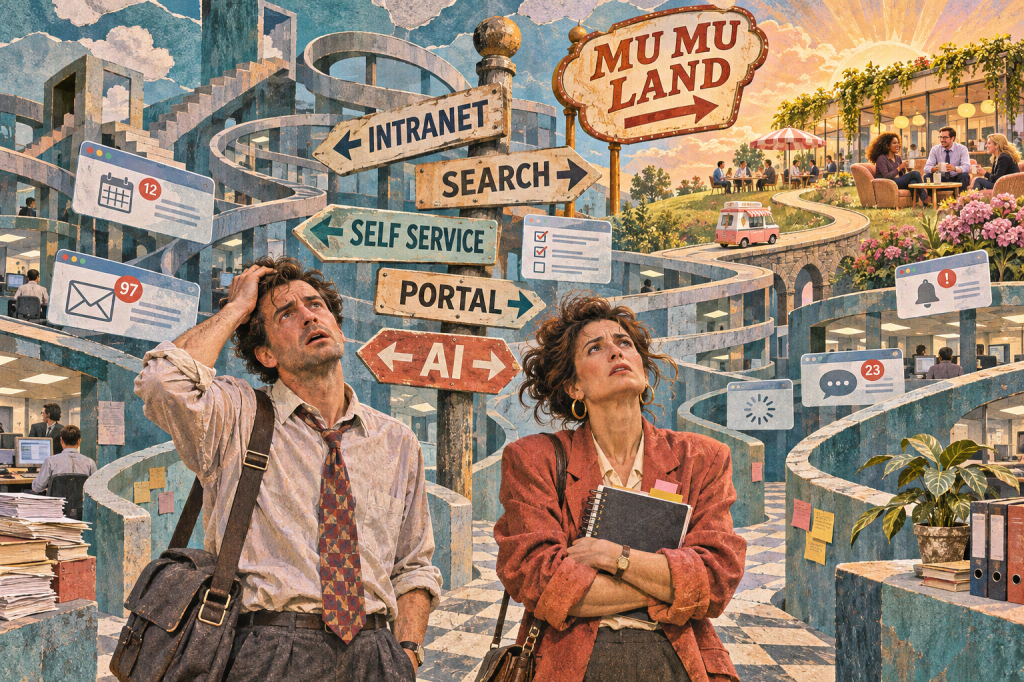
All bound for Mu Mu Land.
If you were around in the early 1990s, you’ll probably remember Justified & Ancient by The KLF. Amid the ice cream vans, ancient tribes and surreal mythology sits a deceptively simple line:
“All bound for Mu Mu Land.”
Mu Mu Land was never a real place. It was a mythical destination. A promised land. Somewhere better. Somewhere freer. Somewhere just over the horizon.
Which makes it the perfect metaphor for modern organisations.
Because for the last thirty years, businesses have been on their own journey to Mu Mu Land.
A place where technology finally makes work easy.
A place where information is available instantly.
A place where every process is frictionless.
A place where employees become hyper-productive.
A place where we somehow achieve more work with less effort.
And yet, despite decades of investment, we never seem to arrive.
The Promise of Mu Mu
Every generation of workplace technology arrives carrying the same promise.
In the 1990s it was intranets.
Finally, all information would be in one place.
No more hunting through filing cabinets. No more asking colleagues where documents were stored.
Then came portals.
One login. One front door. One place for everything.
Then search engines.
Don’t know where something is? Search will find it.
Then knowledge management systems.
Then collaboration platforms.
Then self-service HR.
Then enterprise social networks.
Then digital workplaces.
Then employee experience platforms.
And now AI.
Each wave arrives with a familiar message:
“This time we’ll make work simpler.”
The destination always sounds wonderfully close.
Just one more platform.
Just one more transformation programme.
Just one more rollout.
Just one more strategic investment.
All bound for Mu Mu Land.
The Strange Reality
Yet something odd happens after every technological revolution.
The work rarely disappears.
It simply changes shape.
The filing cabinet disappears, but now we have six different repositories.
The memo disappears, but now we receive hundreds of emails.
Email becomes overwhelming, so we introduce Teams or Slack.
Now the conversation is spread across emails, chats, channels, shared drives and meetings.
Search gets better.
Yet somehow finding things remains difficult.
Self-service systems remove administrative support.
Now employees become their own travel agent, HR administrator, IT support desk and finance clerk.
Processes become digitised.
People become process managers.
The technology works.
But the promised ease never quite materialises.
The Efficiency Paradox
Here’s the uncomfortable truth.
Most workplace technology succeeds in making organisations more efficient.
But not necessarily workers happier.
These are not the same thing.
When a company introduces self-service expense management, payroll portals or automated workflows, the organisation often saves money.
Support teams shrink.
Processing times fall.
Reporting improves.
The business becomes more efficient.
But from the employee’s perspective?
Another task has simply landed on their desk.
What was once somebody else’s job becomes part of yours.
The organisation gets leaner.
The worker gets busier.
Everyone celebrates efficiency gains.
No one notices that thousands of little administrative tasks have quietly migrated onto individual employees.
Information Everywhere, Understanding Nowhere
Perhaps the biggest irony of modern work is that we’ve solved information scarcity but created information overload.
The early intranet vision was compelling.
Put everything in one place and employees will be empowered.
Instead we’ve created something different.
Most organisations now contain:
- Multiple document libraries
- Knowledge bases
- Wikis
- SharePoint sites
- Teams channels
- Training portals
- Policy repositories
- HR systems
- AI assistants
Information is abundant.
Attention is scarce.
The challenge is no longer accessing knowledge.
The challenge is filtering it.
For new starters this can be particularly brutal.
Thirty years ago information might have been harder to find, but there was usually a person who knew the answer.
Today’s new employee can be presented with a dazzling array of systems, portals and AI-powered resources.
Yet still find themselves wondering:
“Who do I actually ask?”
What New Starters Really Need
This is where many organisations misunderstand the problem.
Technology onboarding is easy.
Human onboarding is harder.
Most companies can give a new employee:
- A laptop
- Access credentials
- An AI assistant
- Collaboration tools
- Learning platforms
Within hours.
But can they help them build trust?
Can they help them understand organisational politics?
Can they help them identify who really gets things done?
Can they help them feel they belong?
Those things still emerge through relationships.
Not portals.
Not search engines.
Not AI.
For readers of the Cappuccino Club, many of whom are trying to make sense of the modern workplace, this matters enormously.
Career success rarely comes from knowing which system contains a policy document.
It comes from building networks, understanding people and learning how organisations actually function.
The most valuable workplace knowledge often isn’t documented.
It’s social.
The Community We Stopped Building
Somewhere along the journey to workplace Mu Mu Land, many organisations quietly shifted their investment priorities.
Building communities is difficult.
Technology is easier to buy.
You can launch a new platform in six months.
You can’t manufacture trust on the same timeline.
A procurement team can justify a multi-million-pound technology programme.
It’s much harder to write a business case for mentoring, community building, social connections or informal learning.
Yet when people look back on their happiest workplaces, they rarely talk about the intranet.
They talk about colleagues.
They talk about friendship.
They talk about belonging.
They talk about the team that helped them through a difficult period.
They talk about managers who invested time in them.
The relationships remain.
The platforms are forgotten.
Will AI Be Different?
This is the question hanging over every workplace today.
AI promises a new route to Mu Mu Land.
Documents summarised instantly.
Knowledge available on demand.
Content generated in seconds.
Meetings transcribed automatically.
Administrative burden removed.
And to be fair, AI may genuinely deliver remarkable productivity gains.
It already is in some areas.
But history suggests caution.
Every previous technology wave promised to give us back time.
Instead, organisations often used those gains to increase expectations.
When email sped up communication, we communicated more.
When mobile phones improved availability, we became more available.
When collaboration tools accelerated teamwork, meetings multiplied.
The risk with AI is not that it fails.
The risk is that it succeeds.
If AI allows employees to complete a task in half the time, many organisations will naturally expect twice the output.
The efficiency dividend may not become leisure, reflection or creativity.
It may simply become more work.
The destination moves again.
Mu Mu Land recedes into the distance.
Maybe We’ve Been Travelling to the Wrong Place
Perhaps the real lesson is that organisations have been pursuing a technological utopia when the workplace problem was never purely technological.
Most frustrations at work are not information problems.
They are relationship problems.
They are trust problems.
They are culture problems.
They are belonging problems.
No search engine solves loneliness.
No portal creates friendship.
No workflow builds trust.
No AI generates genuine community.
Technology can absolutely help.
But it cannot replace the social foundations that make work meaningful.
The Cappuccino Club View
The Cappuccino Club has always been interested in the human side of work.
The bits that don’t fit neatly into process maps or transformation roadmaps.
The conversations.
The confusion.
The uncertainty.
The learning.
The relationships.
That’s why the metaphor of Mu Mu Land feels so relevant.
For decades organisations have been chasing a mythical destination where the next piece of technology finally makes work effortless.
Yet every generation discovers the same truth.
Work remains work.
People remain people.
And no matter how sophisticated the systems become, success still depends on the messy, human relationships that sit between them.
So by all means embrace AI.
Experiment with new tools.
Automate what can be automated.
But don’t make the mistake of believing we’re finally about to arrive in Mu Mu Land.
We’ve been travelling there since the first corporate intranets appeared.
We’re still on the bus.
And if history is any guide, we always will be.


Leave a Reply